When Movie Trailers Were an Event — Before YouTube Changed Everything
Before YouTube, trailers weren’t waiting in your pocket seconds after they dropped. You caught them at the cinema, saw them on television, found them on VHS tapes or waited an eternity for a tiny video to download online. Movie trailers haven’t disappeared — but the experience of watching them has changed forever.
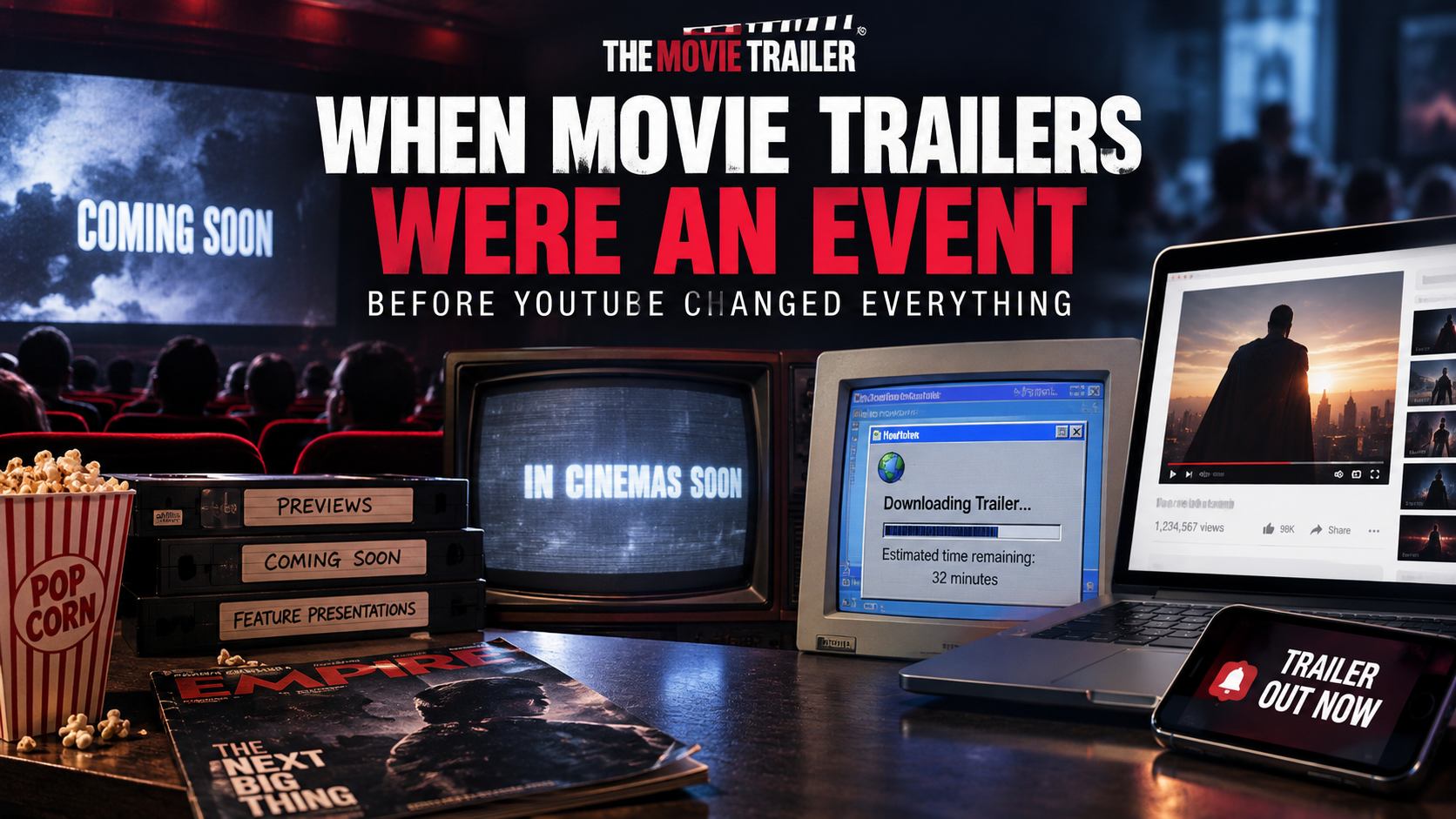
It’s difficult to imagine now.
A new movie trailer arrives today, and within minutes it’s everywhere.
YouTube. TikTok. Instagram. X. Entertainment websites. Group chats. Reaction videos. Frame-by-frame breakdowns.
Pause it. Rewind it. Watch it again. Send it to somebody.
Twenty-four hours later, people have analysed shots that appear on screen for half a second and developed seventeen theories about what they mean.
But movie trailers weren’t always consumed like that.
For generations of movie fans, you often didn’t even know which trailers you were about to see.
You sat down in the cinema.
The lights went down.
The screen went dark.
And then something appeared that you had never seen before.
Sometimes you didn't recognise the movie immediately.
Maybe you recognised an actor.
Maybe a familiar piece of music started playing.
Maybe one spectacular shot made everyone in the cinema suddenly pay attention.
Then the title appeared.
COMING SOON.
And that might genuinely have been the first time you knew the movie existed.
There was something magical about that.
THE CINEMA
The Trailer Was Part of Going to the Movies
Long before trailers became online content, the cinema was their natural home. The clue is in the name. The earliest movie trailers were originally shown after films — they literally trailed the feature presentation — before exhibitors realised audiences weren’t particularly interested in remaining in their seats once the main attraction had finished. Trailers eventually moved before the movie, where they’ve remained ever since. And for decades, that meant seeing a trailer could be an experience in itself.
You weren’t watching it on a six-inch phone screen while making a cup of tea. You were watching it enormous. The sound filled the auditorium. Everyone around you experienced it at the same time. And occasionally a trailer completely changed the atmosphere in the room. You’d hear whispers. Someone would recognise what it was.
People would laugh at the same moment. Then the title appeared, and you made a mental note: We need to see that. No comments underneath telling you whether you should be excited. No view counter. No reaction thumbnails. Just you, the screen and whatever the trailer managed to do in two minutes.
THE VHS YEARS
Sometimes the Trailer Came Home With You
Then movie marketing found another perfect home. VHS. Anyone who rented or bought enough videotapes will remember it. You’d put the tape in expecting the movie, only to find yourself watching trailers for other releases first. Some were skippable. Some weren’t. And some became almost as familiar as the movie you’d actually bought.
Watch the same VHS twenty times, and chances are you watched the same trailers twenty times too. It created a strange form of discovery that barely exists anymore. You weren’t necessarily searching for those films. They found you. A trailer attached to one movie could introduce you to something you’d never heard of. Then the next trip to the video shop came around, and suddenly you recognised the box. "I’ve seen the trailer for that.” That physical relationship with movies is one reason years like 1986 remain so fascinating.
Films including Top Gun, Aliens and Ferris Bueller’s Day Off arrived in a world where cinema, television and increasingly the video shop were central to how audiences encountered movies.
Our sister site Movies in the 80s recently revisited that extraordinary year in 1986: Was 40 Years Ago — Was It the Greatest Year of 1980s Movies?.
But the way audiences discovered movies was about to change.
TELEVISION
You Could Spend All Evening Waiting for One Trailer
Television was another huge part of the equation.
Studios could run shortened versions of theatrical trailers during commercial breaks, especially as a movie neared release.
And unlike today, you couldn’t necessarily summon the full trailer afterwards.
If you missed it, you missed it.
Maybe you’d see it again tomorrow.
Maybe somebody at school or work would describe it badly.
Maybe a movie programme would show clips.
Maybe you’d buy a magazine and stare at a handful of production stills while trying to imagine what the movie actually looked like.
That scarcity gave trailers value.
Seeing thirty seconds of something you were desperate to watch could be genuinely exciting because you didn’t have unlimited access to footage whenever you wanted it.
For younger movie fans especially, information travelled by word of mouth.
"Have you seen the trailer for...?"
That question actually meant something.
1996
Then the Internet Started Sneaking Into the Movie Business
By the mid-1990s, something enormous was happening.
The internet was entering people's homes.
Slowly.
Very slowly.
Anyone who remembers dial-up internet probably just heard the noise in their head.
Movie websites began appearing. Studios experimented with official websites. Fans created pages dedicated to upcoming releases. Images, rumours and production information could travel further and faster than before.
But video remained difficult.
Downloading a trailer wasn't the effortless click-and-watch experience we know now.
Files could be tiny.
Picture quality could be dreadful.
Playback software could be temperamental.
And downloading a few minutes of video over a slow connection could require the patience of a saint.
Yet it felt incredible.
For the first time, the idea was emerging that you might be able to sit at a computer and deliberately find promotional material for a movie rather than waiting for television or the cinema to bring it to you.
1996 sits beautifully at that crossroads.
It was the year of Independence Day, Scream, Twister and Mission: Impossible — enormous movies marketed through the traditional machinery of cinema and television while the internet quietly prepared to transform everything.
We've looked more closely at that year on Movies in the 90s in 1996 Was 30 Years Ago — The Movies That Defined the Middle of the 90s.
Less than a decade later, the transformation would accelerate dramatically.
QUICKTIME
Waiting Half an Hour to Watch Two Minutes of Video
An entire generation of movie fans finds that the word QuickTime unlocks memories.
Movie trailers became one of the early internet’s genuinely exciting uses.
Studios and entertainment websites could offer different versions depending on how ambitious you felt.
Small.
Medium.
Large.
Choosing "large" on a slow internet connection was basically an act of optimism.
You clicked.
You waited.
The progress bar moved.
Eventually you got a little window containing the trailer you'd been desperate to see.
And despite the inconvenience, it felt futuristic.
You could watch a movie trailer when you wanted.
That sounds laughably ordinary today.
At the time, it represented a fundamental change in the relationship between studios and audiences.
The trailer was escaping the cinema.
2005
Then YouTube Arrived
YouTube launched in 2005.
And the idea of internet video changed remarkably quickly afterwards.
Instead of downloading individual video files and opening them in separate software, video could simply live on a webpage.
Click.
Watch.
Share.
That simplicity was transformative.
As broadband connections improved and online video became increasingly normal, the trailer became something different.
It became content.
Studios no longer had to rely entirely on audiences encountering a trailer while doing something else.
They could release it directly online.
Fans could send it to each other.
Entertainment websites could embed it.
Blogs could discuss it.
Eventually, social media would amplify the process further.
The distance between a studio releasing a trailer and an audience seeing it was collapsing.
2006
The Movie Trailer Entered a New World
Which makes 2006 particularly interesting.
Casino Royale.
The Departed.
The Prestige.
Pirates of the Caribbean: Dead Man’s Chest.
Cars.
The Devil Wears Prada.
Rocky Balboa.
These movies arrived only a year after YouTube launched, when traditional movie marketing and rapidly expanding online video were beginning to overlap.
You could still encounter a trailer at the cinema.
You could still see television spots.
DVDs still carried previews.
Movie magazines remained important.
But increasingly, the computer sitting in the corner of the room could show you the trailer too.
Our Movies in the 00s feature 2006 Was 20 Years Ago — The Movies That Defined the 2000s looks back at the films themselves.
From a trailer perspective, however, the period represents something else:
The beginning of the world we live in now.
THE TRAILER DROP
Somewhere Along the Way, Watching Became an Event Again
Here’s the funny thing.
The internet initially removed the scarcity surrounding trailers.
But Hollywood eventually found a way to make them feel like events again.
The trailer drop was born.
Now studios tease the trailer itself.
A poster arrives.
Then perhaps a teaser for the teaser.
A short clip announces that the trailer is coming tomorrow.
A countdown begins.
Then everyone receives it simultaneously.
Within minutes, social feeds fill with screenshots.
Within hours, reaction channels upload videos.
Entertainment sites dissect what was revealed.
Fans analyse every frame.
The communal experience hasn’t disappeared.
It has moved from the cinema auditorium to the internet.
Millions of people might be watching separately, but they’re talking about it together.
TWO MINUTES, THOUSANDS OF THEORIES
We Watch Trailers Differently Now
There's another enormous difference.
We can stop them.
Imagine trying to analyse a theatrical trailer in 1986.
Something flashes onto the screen.
Was that who you thought it was?
Too late.
The next shot has already appeared.
Today?
Pause.
Zoom.
Screenshot.
Increase the brightness.
Compare it with a photograph taken on location six months ago.
Post it online.
Have 4,000 strangers debate whether a blurry shape in the background confirms a character is returning.
Studios know this happens.
Trailer editing has consequently become part marketing, part puzzle.
What do you reveal?
What do you hide?
Can footage be deliberately misleading?
Does showing the biggest moment generate excitement or spoil the movie?
The audience isn’t merely watching anymore.
It's investigating.
THE SPOILER PROBLEM
Have Trailers Started Showing Too Much?
Of course, unlimited access created another problem.
Some trailers reveal an extraordinary amount.
Characters.
Set pieces.
Plot twists.
Surprise appearances.
Sometimes watching a modern trailer feels suspiciously like watching a three-minute summary of the movie.
That creates a difficult balancing act.
A studio needs to convince people to buy a ticket.
The trailer therefore needs exciting material.
But the more material it reveals, the less remains for audiences to discover.
It's why some movie fans deliberately avoid trailers for films they already know they're going to see.
Think about how strange that is.
We went from an era when audiences desperately waited to see a trailer...
...to an era when some audiences actively try to escape them.
PLEASE REWIND
Maybe Scarcity Made Movie Hype More Fun
We're not going to pretend everything was better before the internet.
It wasn't.
Being able to watch a trailer instantly is brilliant.
Discovering independent movies from the other side of the world is brilliant.
Having filmmakers able to reach audiences without needing an enormous television advertising campaign is brilliant.
But something was lost when everything became permanently available.
The waiting.
The surprise.
The mystery.
Our friends at Please Rewind recently looked across 1986, 1996 and 2006 — three movie years separated by decades but united by the memories audiences still attach to them.
Those memories aren't only about the movies.
They're about how we discovered them.
Seeing a trailer unexpectedly before another film.
Catching thirty seconds on television.
Finding a preview on a VHS.
Waiting for QuickTime to buffer.
Watching an online trailer for the first time.
Or sending somebody a YouTube link with three words:
"WATCH THIS NOW."
The technology changed.
The screens changed.
The delivery changed.
But that little moment when a trailer gets everything right hasn’t changed very much at all.
The music builds.
The editing gets faster.
One final shot.
Black screen.
Then the title appears.
And you think:
I need to see that movie.
That’s why, after more than a century of cinema, the movie trailer still matters.