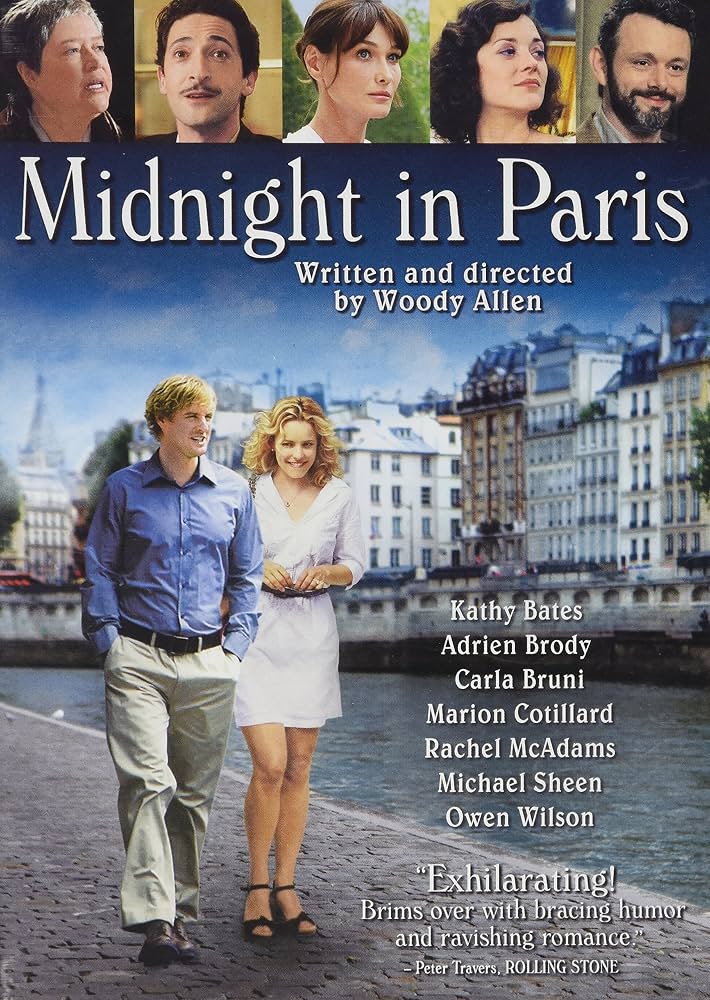
Midnight in Paris
“Every night at midnight, Paris opens the door to another time.”
Director
Woody Allen
Release
7 October 2011
Runtime
94 Minutes
Certificate
12A
Synopsis
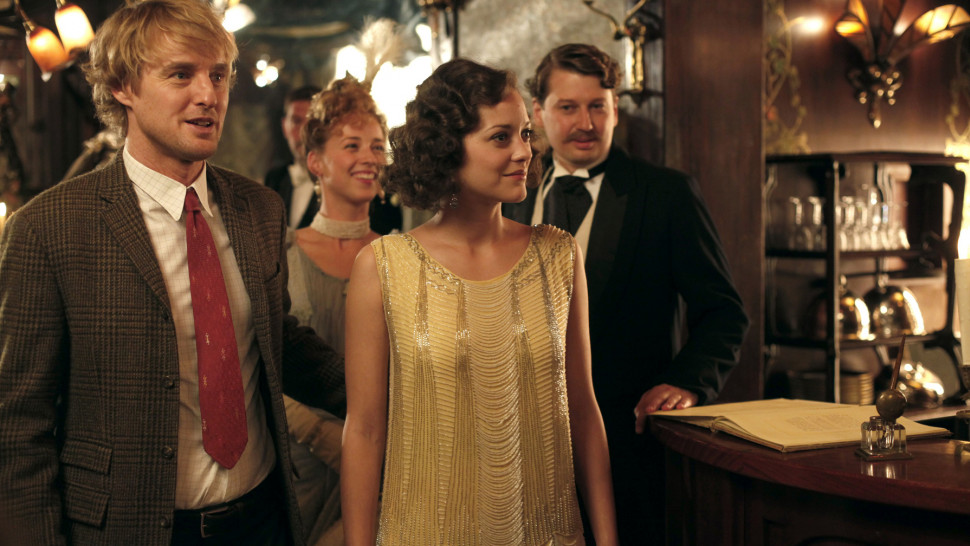
Gil Pender has the sort of career many aspiring writers would envy. He earns good money writing Hollywood screenplays. But Gil doesn't see himself as successful. What he really wants is to finish his novel and become the kind of writer he has always admired. A trip to Paris with his fiancée Inez should inspire. Instead, it exposes just how differently the two of them imagine their future. Gil adores Paris. He talks about living there. He romanticises walking through its streets in the rain and imagines the city during the artistic explosion of the 1920s. Inez doesn't share the fantasy. Their differences become even more obvious when they encounter Paul, an intellectual acquaintance of Inez whom Gil finds almost unbearable. One evening, Gil leaves the others and walks through Paris alone. He becomes lost. Then the clock strikes midnight. An old-fashioned car stops nearby, and its passengers invite him inside. Gil accepts. What follows seems impossible. The car delivers himtoe Parisinf the 1920s. There he encounters Zelda and F. Scott Fitzgerald, Ernest Hemingway and eventually Gertrude Stein, who even agrees to look at Gil's manuscript. And then there's Adriana. Beautiful, fascinating and surrounded by the artists Gil has spent years idolising, Adriana appears to belong perfectly to the world he wishes were his own. Gil begins returning night after night. Modern Paris becomes something he tolerates during the day while waiting for midnight to arrive. Yet Adriana has her own fantasy. She doesn't believe the 1920s represent Paris's greatest age. She dreams about the Belle Époque. Gil slowly begins to understand the trap. Perhaps everybody imagines happiness waiting somewhere else. Another city. Another career. Another relationship. Another era. And perhaps constantly dreaming about yesterday is simply another way of avoiding today. That theme — the belief that another existence would necessarily be better — sits explicitly at the centre of Sony's official description of the film.
The Movie Trailer
Midnight in Paris is a romantic fantasy about a writer who falls in love not simply with Paris, but with the possibility that he might have been born in the wrong time.
Gil Pender is a successful Hollywood screenwriter who dreams of becoming a serious novelist.
While visiting Paris with his fiancée Inez and her family, Gil finds himself increasingly enchanted by the city — and increasingly uncertain about the life waiting for him back home.
Then, during a solitary walk through Paris late one evening, something impossible happens.
At midnight, a mysterious car arrives.
Gil gets inside.
And suddenly the Paris around him isn't the modern city he left moments earlier.
It's the 1920s.
Before long, Gil is drinking and talking with some of the writers and artists he has spent his life idolising.
F. Scott Fitzgerald.
Ernest Hemingway.
Gertrude Stein.
Salvador Dalí.
And among them he meets Adriana, a woman whose own fascination with an earlier age begins to mirror Gil's obsession with the past.
Every night, midnight gives Gil another chance to escape into the world he believes he should have lived in.
But eventually he must decide whether the past really was better — or whether longing for another life is preventing him from living his own.
Sony describes the film as a romantic comedy set in Paris, built around an engaged couple and the seductive illusion that another life would be better than the one we have.
MIDNIGHT
Paris Changes When the Clock Strikes Twelve
Gil doesn't discover a machine covered in flashing lights or receive an explanation for what is happening.
He waits until midnight.
A car arrives.
And Paris opens a door.
That simplicity is part of what makes the fantasy work.
Gil doesn't spend his nights attempting to understand how he has travelled into the past.
He embraces it.
For a frustrated writer obsessed with the literary world of the 1920s, this isn't something to investigate.
It's paradise.
The problem is that once Gil discovers a world he prefers to his own, returning to reality becomes increasingly difficult.
THE GOLDEN AGE
Everybody Wants to Live Somewhere Else
Gil is convinced that Paris in the 1920s was a better place to be alive.
Then he meets Adriana.
She lives inside Gil's dream era, surrounded by extraordinary writers and artists.
Yet Adriana doesn't consider herself fortunate.
For her, the truly magical Paris existed decades earlier during the Belle Époque.
Suddenly Gil is confronted by his own nostalgia from the opposite direction.
The past he considers perfect wasn't perfect for the people actually living through it.
They were looking backwards too.
Midnight in Paris turns that idea into something bigger than a joke about nostalgia.
There will always be another time that appears more romantic than the present because we never had to experience its ordinary days.
GIL & INEZ
The Wrong Era May Not Be Gil's Real Problem
At first, Gil believes his dissatisfaction comes from his career.
Then perhaps it's Los Angeles.
Then perhaps he belongs in Paris.
Then perhaps he belongs in Paris ninety years earlier.
But the farther Gil travels into his fantasy, the more obvious his problems in the present become.
He and Inez don't simply disagree about where they should live.
They want fundamentally different lives.
The impossible nights therefore give Gil something more important than access to his heroes.
They give him distance.
For perhaps the first time, Gil can look at the future he is heading towards and ask whether it is actually the future he wants.
The past may be impossible to keep.
But that doesn't mean the present has to remain unchanged.