The Odyssey Review: Christopher Nolan Makes the Ancient World Feel Monumental Again
Christopher Nolan turns one of the oldest stories ever told into a modern cinematic epic. The Odyssey is visually staggering, brutally physical and far more interested in the cost of Odysseus's journey than simply ticking off gods and monsters. It isn't a flawless adaptation of Homer, but as a big-screen experience, few films this year can touch it.
Few filmmakers could have looked at a poem written nearly 3,000 years ago and thought: this needs IMAX.
Christopher Nolan did.
With The Odyssey, Nolan takes Homer's story of Odysseus and his seemingly impossible journey home from the Trojan War and transforms it into the kind of gigantic theatrical event Hollywood increasingly seems afraid to make.
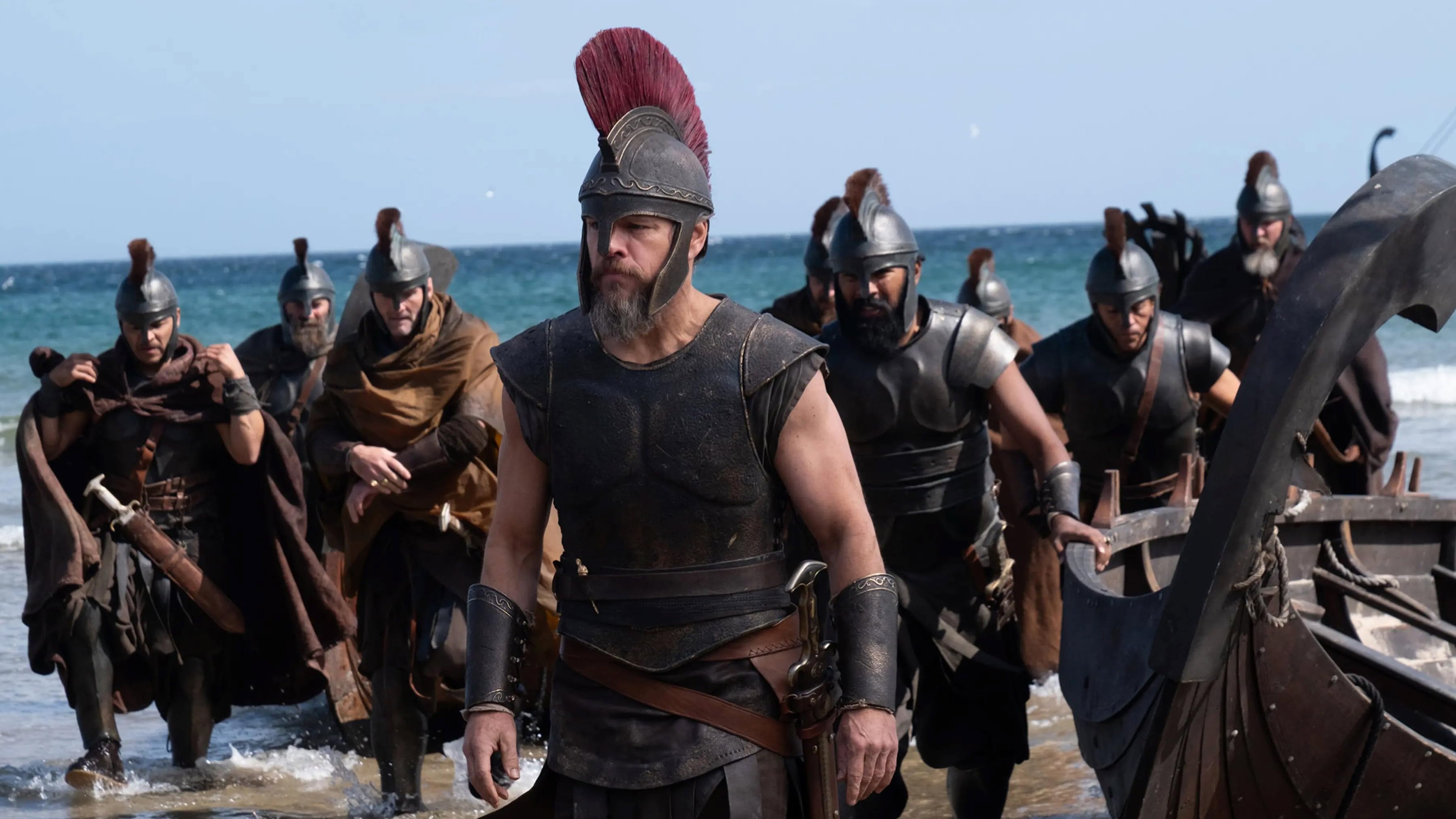
Ships crash through violent seas; armies, gods, monsters, and ruined cities make human beings seem almost insignificant.
Yet underneath all that spectacle is a surprisingly simple idea.
What happens when the hero finally has to live with what he has done?
Matt Damon's Odysseus isn't merely trying to get back to Ithaca. He's carrying Troy home with him.
And that decision gives Nolan's The Odyssey considerably more weight than a three-hour procession of mythical creatures ever could.
AN EPIC JOURNEY
Nolan Understands That The Odyssey Has to Feel Enormous
HEADLINE
Nolan Understands That The Odyssey Has to Feel Enormous
A Christopher Nolan adaptation of The Odyssey always risked becoming a scale exercise.
Instead, scale becomes part of the storytelling.
The sea feels dangerous. The landscape feels endless. Ships appear painfully small against the world surrounding them, and Odysseus's journey increasingly feels less like travelling from one location to another than attempting to escape a world determined to keep him wandering.
Nolan and cinematographer Hoyte van Hoytema make the physical world essential to the movie.
That matters because mythology can become strangely weightless on screen once everything starts looking computer-generated.
Here, even the impossible frequently feels tangible.
The result is a film that reminds you why a cinema screen can still offer something fundamentally different from watching a movie at home.
This isn't simply a story being told at enormous scale.
It's a story that benefits from feeling enormous.
THE MAN BEHIND THE MYTH
Matt Damon Gives Odysseus Something More Interesting Than Heroism
Nolan's smartest decision is to refuse to treat Odysseus as an uncomplicated action hero.
Matt Damon plays him as a man gradually crushed by the consequences of his own cleverness.
The Trojan Horse may have helped end a war, but victory doesn't bring peace. It creates another burden for Odysseus to carry.
That gives Damon's performance a sadness that becomes more important as the journey continues.
This is a warrior capable of extraordinary things who increasingly understands that surviving isn't necessarily the same thing as winning.
Damon doesn't attempt to make Odysseus larger than life.
He does almost the opposite.
He finds the exhausted human being trapped inside the legend.
And when the movie works emotionally, it is usually because Nolan allows that man to emerge from underneath all the mythology.
GODS AND MONSTERS
The Famous Encounters Feel Dangerous Again
Everybody knows some part of The Odyssey.
The Cyclops. Circe. The Sirens. Calypso. The journey into the underworld.
That familiarity creates a strange challenge because Nolan has to make encounters that have existed in popular culture for centuries feel unpredictable.
For the most part, he succeeds.
Rather than presenting mythology as glossy fantasy, Nolan gives much of it a physical, unsettling quality.
The Cyclops sequence isn't memorable merely because there's a monster in it. What matters is the feeling of human beings entering somewhere they don't belong and discovering that intelligence may not be enough to save them.
The underworld, meanwhile, becomes something stranger and more psychologically disturbing.
These sequences work because Nolan rarely seems interested in simply showing us the famous thing.
He's interested in what encountering that thing does to Odysseus.
The monsters become another form of memory, guilt and fear.
WAITING IN ITHACA
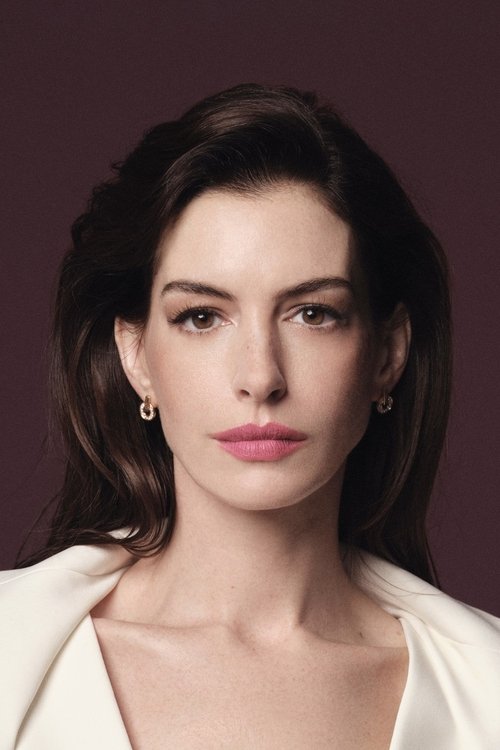
Anne Hathaway Gives the Story Its Emotional Destination
For all the attention given to Odysseus's voyage, the movie needs Ithaca to matter.
Anne Hathaway makes sure it does.
Her Penelope isn't simply a prize waiting at the end of the adventure. She represents the life Odysseus believes he is fighting to recover, even as that life continues changing without him.
Tom Holland's Telemachus carries another part of that cost.
He has grown up in the shadow of a father who exists more as mythology than memory.
And Robert Pattinson has tremendous fun as Antinous, bringing genuine menace to the group of suitors circling the apparently abandoned throne.
However, there is a legitimate weakness here.
Nolan's determination to centre Odysseus sometimes leaves other characters with less space than they deserve.
Several of Homer's women in particular lose complexity or agency in the transition.
For a film approaching three hours with this extraordinary cast, there are moments where you wish Nolan would allow some of them to breathe a little longer.
THE COST OF WAR
This Isn't Really a Film About Getting Home
The most interesting interpretation running through The Odyssey is that Odysseus's real journey isn't geographical.
The war is over.
But nobody has escaped it.
Troy follows these characters across the sea.
Nolan repeatedly returns to the consequences of violence and the uncomfortable gap between the stories civilisations tell about their victories and what those victories actually required.
Odysseus is celebrated because he was clever enough to devise the strategy that defeated Troy.
But what happens when the clever man starts thinking about everybody who died because his idea worked?
That question turns an ancient adventure into something surprisingly contemporary.
The further Odysseus travels, the more the movie begins to feel like a story about memory: what people remember, what they choose to forget and the stories they create to make terrible events easier to live with.
It's unmistakably Nolan territory.
Time, memory and consequence have always fascinated him.
Homer gives him perhaps the oldest canvas imaginable on which to explore them.
NOT QUITE HOMER
The Film's Biggest Strength Is Also Its Biggest Weakness
Nolan hasn't made a museum-piece adaptation of The Odyssey.
He's made a Christopher Nolan film out of The Odyssey.
Those aren't quite the same thing.
Characters are changed. Events are rearranged. Some elements disappear completely, while others are altered to support Nolan's interpretation of Odysseus as a man reckoning with trauma and responsibility.
That approach gives the movie a strong emotional spine.
It also strips away some of the strange moral complexity that makes Homer's Odysseus such a fascinating figure.
Occasionally the dialogue feels too modern or too determined to explain what the imagery has already communicated.
And despite the enormous running time, certain supporting characters and relationships pass surprisingly quickly.
Purists will have plenty to argue about.
Perhaps that's inevitable.
A story that has survived for thousands of years doesn't need protecting from another interpretation.
The more important question is whether Nolan's interpretation has something worthwhile to say.
It does.
PURE CINEMA
This Is Why Christopher Nolan Keeps Fighting for the Big Screen
There are films you watch.
Occasionally, films are designed to overwhelm you.
The Odyssey belongs firmly in the second category.
Nolan's commitment to IMAX-scale filmmaking isn't a marketing gimmick here. The enormous landscapes, violent seas, battles and moments of eerie silence are integral to the experience.
But spectacle alone wouldn't make the movie memorable.
What elevates it is the contrast between that enormous world and one increasingly exhausted man trying to find his way through it.
The gods may be watching.
The monsters may be waiting.
The sea may stretch seemingly forever.
Yet ultimately The Odyssey becomes about something much smaller.
A husband trying to return to his wife.
A father trying to return to his son.
And a soldier trying to return from a war that ended years ago.
That's where Nolan finds the humanity inside the myth.
The Verdict
The Odyssey is Christopher Nolan operating at almost absurd scale without losing sight of the damaged human being at the centre of the story. Matt Damon delivers a weary, thoughtful Odysseus, Anne Hathaway gives Ithaca genuine emotional weight, and Nolan and Hoyte van Hoytema create images that demand the biggest screen available. Some of Homer's complexity is sacrificed to fit Nolan's interpretation, several supporting characters deserve more room, and the dialogue occasionally explains too much. But those shortcomings struggle to diminish the sheer ambition of what has been achieved. Thousands of years after Odysseus first attempted to find his way home, Nolan makes the journey feel dangerous, strange and monumental again.
In This Review