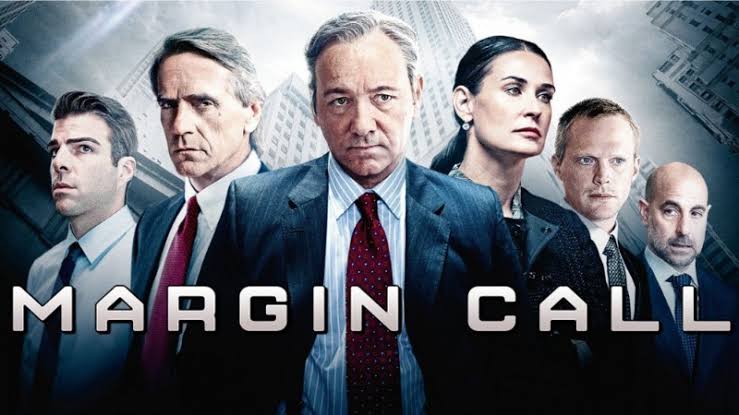
Margin Call
“By morning, the numbers won't be their biggest problem.”
Director
J.C. Chandor
Release
13 January 2012
Runtime
106 Minutes
Certificate
15
Synopsis
Eric Dale knows something is wrong. He's been studying the firm's risk exposure, but before he can finish his work, he's included in a mass round of redundancies. His access is shut down. His career with the company is over. But before leaving, he gives a USB drive containing his unfinished calculations to Peter Sullivan. Peter isn't simply another financial analyst. His background in engineering and mathematics allows him to understand what Dale had begun to uncover. So after most of the office has emptied, Peter keeps working. Eventually he completes the model. The result is catastrophic. The firm's exposure to volatile assets has reached a point where relatively small market movements could produce losses greater than the company's entire market value. Peter contacts his colleague Seth Bregman and their superior Will Emerson. Will immediately understands that the discovery is too serious to wait until morning. The information begins climbing through the company's hierarchy. Sam Rogers is brought in. Then Jared Cohen. Then Sarah Robertson. Finally, the firm's chief executive, John Tuld, arrives. Now the question isn't whether the company is in trouble. Everybody in the room understands that it is. The question is what they'll do about it. Their solution is brutal. When trading begins, the firm can rapidly sell its toxic assets before the wider market understands how worthless they may be. Doing so could save the company. But it would transfer enormous losses to customers and counterparties while destroying relationships built over years. Sam understands exactly what that means. Once the firm's traders begin selling assets they know are dangerous, the market will quickly realise something is wrong. Trust will disappear. Careers may be destroyed. Other companies may suffer. But the people sitting around the table aren't being asked to save the financial system. They're being asked to save their company. And morning is getting closer.
The Movie Trailer
Margin Call is a tense financial thriller set inside an investment bank during one extraordinary night at the beginning of the 2008 financial crisis.
The working day is already brutal.
Employees are being dismissed, careers are disappearing, and nobody knows who will be next.
Among those suddenly leaving the building is senior risk analyst Eric Dale.
Before he goes, Dale hands junior analyst Peter Sullivan a piece of unfinished work.
He tells him to be careful.
Peter stays behind and completes the calculations.
What he discovers is terrifying.
The firm's financial models are no longer protecting it from risk.
They're hiding a disaster.
If the market moves far enough in the wrong direction, the losses could exceed the value of the entire company.
One discovery begins travelling upwards through the organisation.
Analysts become managers.
Managers become executives.
Executives summon the people above them.
Until, in the middle of the night, some of the company's most powerful people sit around a conference table deciding what they are prepared to do before the markets open.
THE DISCOVERY
One Spreadsheet Is About to Destroy Everything
No explosion happens when Peter Sullivan discovers the problem.
No alarm sounds.
Nobody runs screaming through the building.
He simply looks at the numbers.
That's what makes Margin Call so effective.
The threat exists inside calculations most people outside the room wouldn't understand.
But Peter understands them.
And once he does, there's no putting the information back inside the computer.
Within hours, something a junior employee discovered reaches the highest levels of the company.
Every person who sees the figures asks essentially the same question.
Not: How did this happen?
What do we do now?
THE MEETING
The People at the Top Finally See the Numbers
By the time John Tuld arrives, the atmosphere has changed.
The analysts who found the problem are now sitting alongside people who can decide the fate of the entire company.
Tuld doesn't need every mathematical detail.
He needs the situation explained clearly.
How bad is it?
How quickly can it get worse?
And most importantly — how can they survive it?
That final question changes everything.
Because survival doesn't necessarily mean fixing the problem.
It may simply mean making sure somebody else is holding it when everything collapses.
THE MORNING
Somebody Is Going to Pay for This
Margin Call isn't really about whether the firm's plan will work.
It's about what success would mean.
Selling the assets could protect the company from catastrophic losses.
But everyone involved understands what they're selling.
The people on the other side of those trades don't.
That's where the financial problem becomes moral.
Employees who spent years building relationships are ordered to burn them in a single morning.
Some object.
Others negotiate.
Some simply do what they're told.
And the higher the decision travels through the company, the easier it becomes to describe devastation as necessity.
Nobody believes the consequences will disappear.
They're simply trying to make sure those consequences fall on somebody else.