
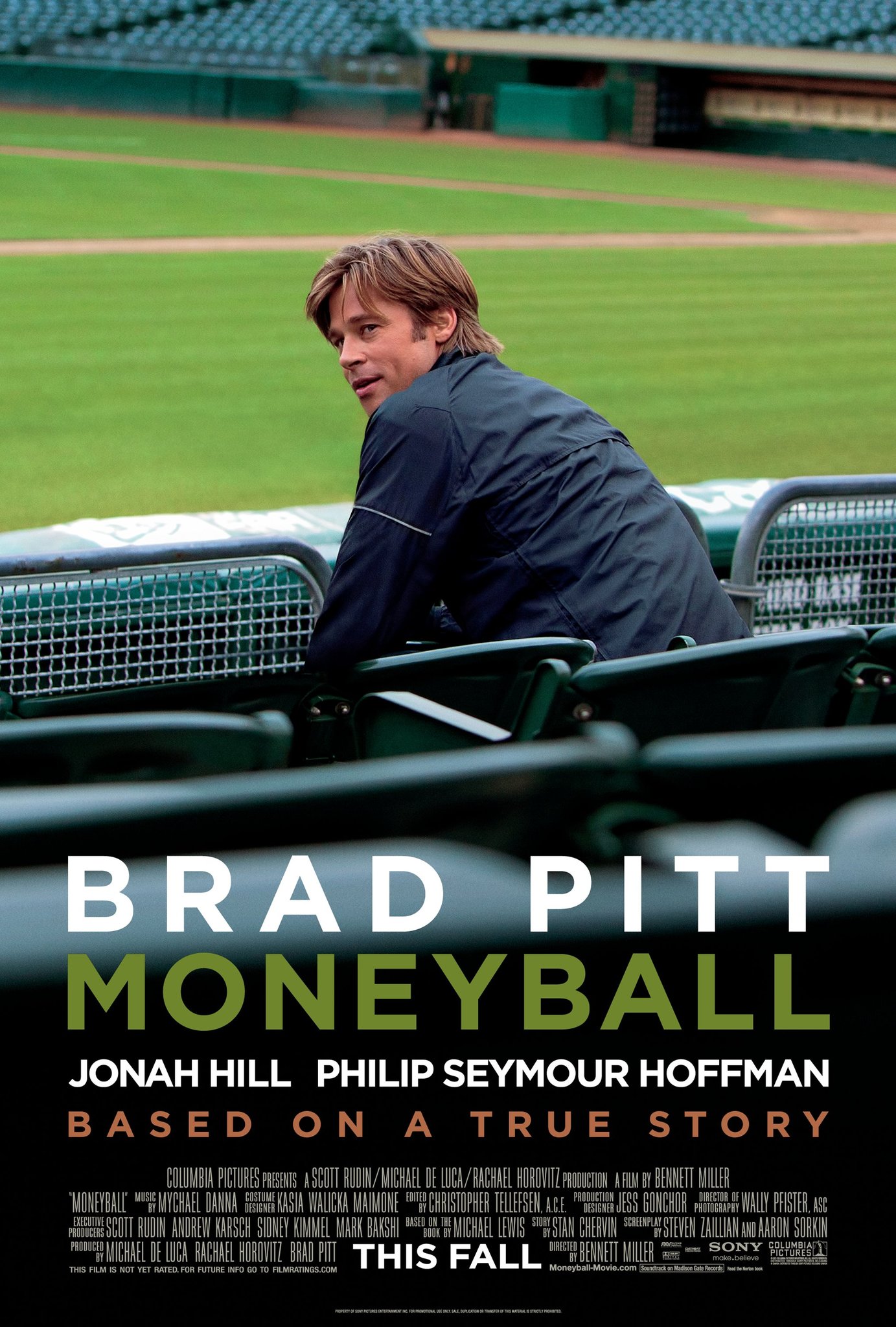
Moneyball
“If you can't beat baseball's richest teams with money, change the way the game is played.”
Director
Bennett Miller
Release
25 November 2011
Runtime
133 Minutes
Certificate
12A
Synopsis
Billy Beane understands what it's like to be valued incorrectly by baseball. Once considered a hugely promising young player himself, his playing career never developed the way scouts predicted. Years later, as general manager of the Oakland Athletics, Billy faces a different problem with the same system. His successful team is being picked apart by wealthier clubs. Oakland simply doesn't have enough money to compete with them conventionally. During negotiations with another organisation, Billy meets Peter Brand, whose approach to evaluating players immediately catches his attention. Peter believes baseball focuses on the wrong things. Rather than relying primarily on traditional scouting instincts and reputations, he believes statistics can identify players whose ability to contribute to victories is being undervalued by the market. Billy sees an opportunity. He begins recruiting players other teams don't want, creating a roster that makes little sense to Oakland's experienced scouts and puts him into conflict with field manager Art Howe. Initially, the results appear to prove Billy's critics right. Then Oakland starts winning. And keeps winning. What began as one cash-strapped team's attempt to survive gradually becomes a challenge to some of baseball's oldest assumptions.
The Movie Trailer
Moneyball is a 2011 sports drama starring Brad Pitt as Billy Beane, general manager of the Oakland Athletics and a man attempting to compete in Major League Baseball without the enormous financial resources available to rival teams.
After losing several important players, Billy faces a seemingly impossible problem.
Oakland cannot afford to replace its stars with equally expensive talent.
Instead of accepting that disadvantage, Billy begins questioning the way baseball teams decide what a player is worth.
His search for another approach leads him to Peter Brand, played by Jonah Hill, a young economics graduate whose statistical analysis challenges decades of conventional baseball wisdom.
Together they begin assembling a team from players other clubs have overlooked, undervalued or dismissed.
The idea sounds ridiculous to baseball's traditional scouts.
Billy believes it might be the only way Oakland can win. Sony describes the film around precisely this battle between Beane's limited budget, conventional baseball thinking and his new numbers-driven approach.
AN UNFAIR GAME
Billy Beane Can't Outspend Baseball's Richest Teams
Billy Beane's problem isn't that he doesn't know which players he wants.
It's that Oakland cannot afford them.
The Athletics operate in a league where wealthier organisations can simply offer successful players more money, leaving smaller teams constantly rebuilding what they've created.
Billy realises that competing under the same rules will produce the same result.
So he stops asking how Oakland can afford the players everyone wants.
He begins asking which players everyone else has misunderstood.
That change in thinking becomes the foundation of Moneyball.
CHANGE THE NUMBERS
Peter Brand Sees Value Where Baseball's Scouts See Flaws
Peter Brand doesn't look at a baseball player the same way the traditional scouting room does.
Where scouts see age, appearance, technique or reputation, Peter sees numbers.
More importantly, he sees value.
His analysis suggests that certain players can contribute far more than their market price implies because baseball's conventional wisdom has systematically undervalued particular skills.
Billy immediately understands what that means for Oakland.
If every club is competing for the same highly rated players, the Athletics will always lose to teams with deeper pockets.
But if Peter can identify productive players nobody else wants, Oakland can build a competitive roster without paying superstar prices.
The theory sounds simple.
Betting an entire season on it is something else entirely.
CHANGE THE GAME
Moneyball Is About More Than Winning a Baseball Season
The most interesting question in Moneyball isn't simply whether Oakland wins.
It's whether Billy Beane can prove that a system everyone trusts might be wrong.
Every defeat gives traditionalists another reason to dismiss his experiment.
Every victory makes ignoring it harder.
Billy's struggle therefore becomes larger than one season or one baseball club.
He's challenging an institution filled with people who have spent their careers believing they understand how successful teams are built.
Changing their minds requires more than an argument.
Billy needs results.
And once those results arrive, baseball has to decide whether what happened in Oakland was an anomaly — or evidence that the game itself has changed.