
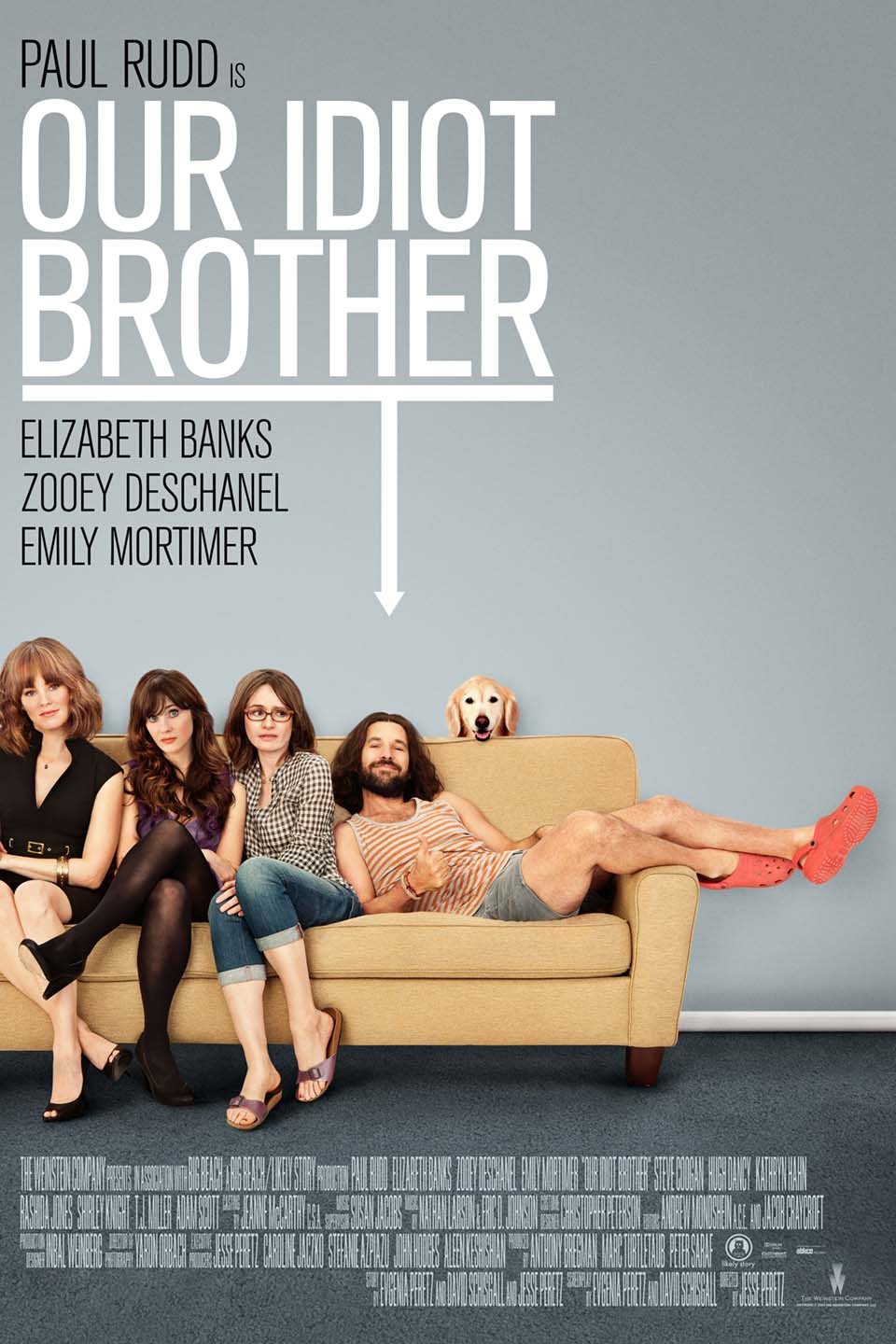
Our Idiot Brother
Ned trusts everybody, tells the truth and assumes people mean well. His sisters are beginning to wish he'd stop.
Director
Jesse Peretz
Release
26 August 2011
Runtime
90 Minutes
Certificate
15
Synopsis
Ned Rochlin lives and works on an organic farm with his girlfriend Janet. His life isn't particularly ambitious, but he's happy. Then Ned encounters a police officer who claims he's had a difficult week and wants to buy some marijuana. Ned initially refuses. Then sympathy gets the better of him. He sells it. The officer arrests him. It tells us almost everything we need to know about Ned. After serving his sentence, he returns to the farm only to discover Janet has moved on and doesn't particularly want him back. Even worse, she keeps Willie Nelson. Ned therefore turns to his mother and three sisters. Miranda is an ambitious journalist desperate to advance her career. Natalie is an independent, free-spirited woman whose relationship with Cindy is becoming complicated. Liz is married to documentary filmmaker Dylan and increasingly unhappy with their marriage. Ned moves between their lives with no intention of causing trouble. He doesn't manipulate anyone. He doesn't deliberately reveal secrets. He simply talks. And because Ned assumes everyone else values honesty as much as he does, information that most people would carefully conceal tends to escape whenever he's around. Relationships begin unravelling. Secrets surface. Careers are threatened. And Ned's sisters increasingly conclude that their brother is responsible for the chaos. But Ned hasn't created most of their problems. He's merely made them considerably harder to ignore.
The Movie Trailer
Ned Rochlin has a remarkably uncomplicated view of the world.
He trusts people.
He believes honesty is usually the best policy.
And he tends to assume everyone else is basically decent.
Unfortunately, Ned's faith in humanity isn't always supported by the evidence.
After making the spectacularly poor decision to sell marijuana to a uniformed police officer, Ned ends up in jail.
When he's released, things aren't much better.
His girlfriend Janet has replaced him on their organic farm and refuses to give Ned custody of his beloved dog, Willie Nelson.
With nowhere else to go, Ned turns to his family.
His three sisters — Miranda, Natalie and Liz — have very different lives, relationships and problems.
One by one, they attempt to help their brother.
And one by one, Ned's almost pathological honesty begins exposing everything they'd rather keep hidden.
Ned might be the family idiot.
Or perhaps he's simply the only one who isn't pretending everything is fine.
NED
Ned's Biggest Problem Is Believing Everyone Else Is as Honest as He Is
Ned isn't stupid in quite the way his family thinks he is.
He's trusting.
That distinction drives almost everything that happens in Our Idiot Brother.
Most people instinctively understand when something shouldn't be repeated, when a question shouldn't be answered or when honesty would make a situation considerably more difficult.
Ned doesn't operate that way.
He assumes that telling the truth should ultimately make things simpler.
For his sisters, who have constructed parts of their lives around compromises and carefully maintained secrets, having Ned around is like inviting a human wrecking ball into the house.
Except the wrecking ball genuinely thinks it's helping.
THE SISTERS
Ned Doesn't Create Their Problems — He Just Makes Them Impossible to Hide
Miranda, Natalie and Liz initially have an obvious explanation for everything going wrong.
Ned.
He arrives in their lives, and suddenly relationships collapse, uncomfortable truths emerge, and carefully constructed plans fall apart.
But blaming Ned avoids a more difficult question.
How much of the damage actually belongs to him?
Ned doesn't create the cracks in his sisters' lives.
Most of them were already there.
His honesty simply removes the convenient layers covering them.
And once those disappear, everyone has to decide whether rebuilding the illusion is really preferable to confronting what's underneath.
HONESTY
Maybe Being the Family Idiot Isn't the Worst Thing Ned Could Be
The movie's central joke gradually shifts.
At first, Ned appears hopelessly naïve.
Selling marijuana to a police officer because the man seems unhappy isn't exactly evidence of excellent judgement.
But the longer Ned spends with his family, the more complicated that judgement becomes.
His sisters are smarter, more successful and considerably better at navigating adult life.
They're also capable of lying to themselves and each other in ways Ned simply doesn't understand.
His optimism creates chaos.
But it also forces people to confront things they've been avoiding.
Perhaps Ned needs to become slightly less trusting.
His family might need to become slightly more like him.